
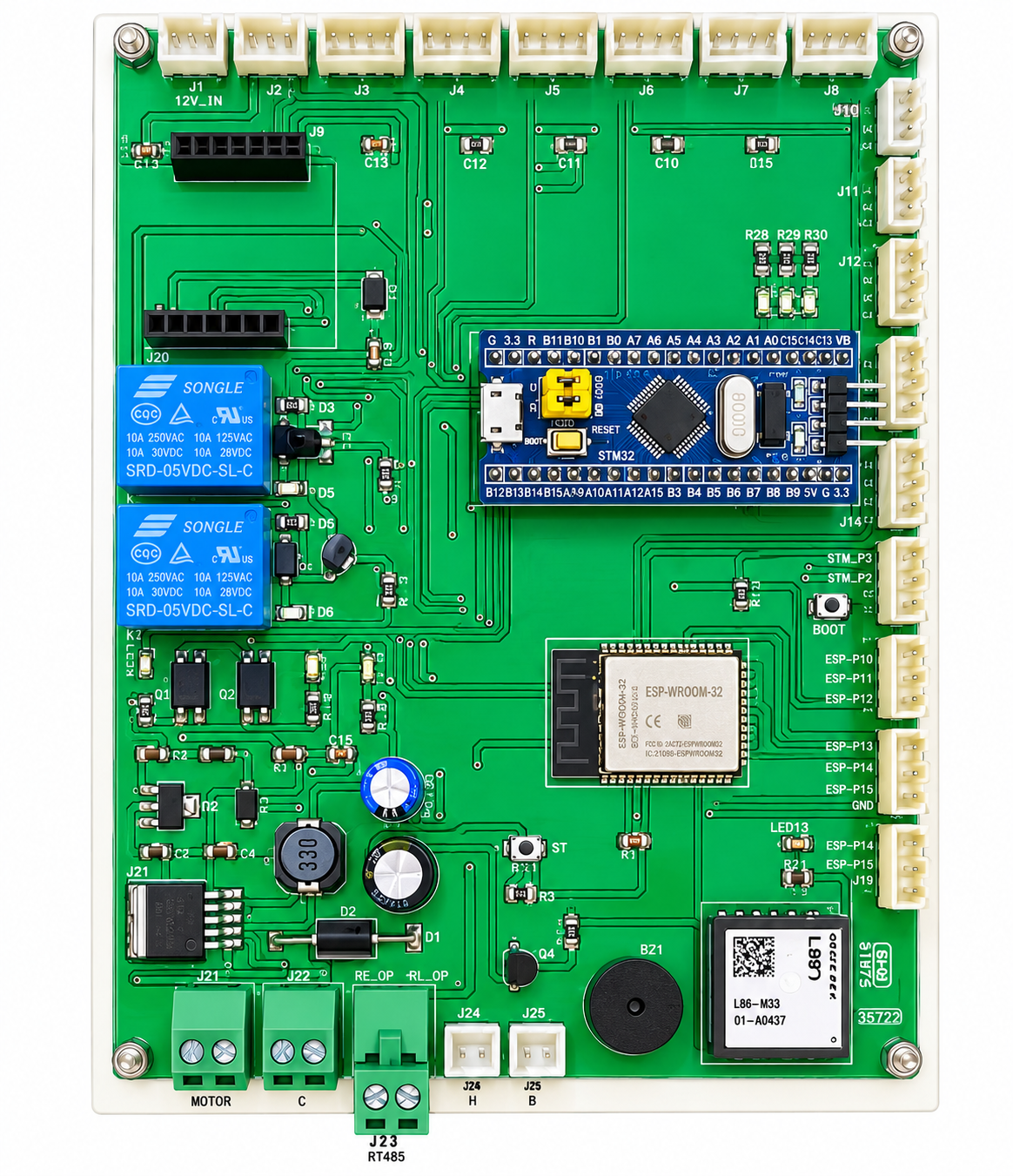
Industrial IoT Controller Board – STM32 + ESP32 + GSM/GPS + RS485 + Dual Relay
1 in stock
Industrial multi-controller IoT development board featuring STM32 and ESP32 controllers, GSM/GPRS connectivity, GPS positioning, RS485, UART interfaces, dual relay outputs and multiple configurable I/O connections. Designed for industrial automation, remote monitoring, telemetry, machine control, tracking and custom IoT product development.
OEM / Customization Available: Firmware, communication protocol, I/O configuration, PCB modifications and application-specific customization can be provided for bulk/industrial requirements.
Bulk/OEM pricing: Contact for quotation
₹11,798.82 ₹15,338.82 (Incl. GST)
1 in stock
Key Product Features
- Dual-controller architecture – STM32 + ESP32
- STM32 microcontroller for real-time control and I/O processing
- ESP32 module for Wi-Fi and Bluetooth connectivity
- GSM/GPRS cellular communication module
- GPS/GNSS location capability
- Remote data transmission over cellular network
- Wi-Fi connectivity
- Bluetooth/BLE capability
- RS485 communication interface
- UART serial communication interfaces
- FTDI/UART programming interface
- Multiple external input/output connectors
- Multiple STM32 GPIO connections
- Multiple ESP32 GPIO connections
- 2 onboard relay outputs
- Relay-based external load/control interface
- Dedicated motor/output connection
- External field-device connectivity
- Multiple JST-style plug-in connectors
- Screw-terminal connections for field wiring
- 12V DC input
- Onboard voltage regulation/power-management section
- Status LEDs
- User/programming push buttons
- Onboard buzzer for audible indication/alarms
- Boot/reset controls
- Modular controller design allowing firmware customization
- Mounting holes for enclosure/panel integration
Communication Interfaces
This is one of the strongest selling points, so I would give it a separate section:
Wi-Fi: Via ESP32
Bluetooth/BLE: Via ESP32
GSM/GPRS: Cellular remote connectivity
GPS/GNSS: Location/tracking
RS485: Industrial wired communication
UART: Controller/peripheral communication
FTDI/UART: Firmware programming/debugging
Depending on the exact GSM/GPS module fitted, we should state the supported cellular technology precisely—for example 2G/4G/LTE—only after confirming the module part number. The visible module marking isn’t clear enough for me to state that confidently from this image.
I/O & Control Features
The board can be described as supporting:
Digital Inputs: Multiple external inputs through dedicated connectors
Digital Outputs: Multiple controller GPIO outputs
Relay Outputs: 2 onboard electromechanical relays
Motor/Load Interface: Dedicated terminal connection visible on PCB
Sensor Interfaces: Multiple connectors for external sensors/modules
UART Devices: External serial peripherals
RS485 Devices: Industrial sensors/meters/controllers
Alarm Output: Onboard buzzer
Status Indication: Multiple LEDs
Potential Applications
This board can be marketed for:
- Industrial IoT gateways
- Machine monitoring systems
- Remote equipment monitoring
- GPS vehicle/equipment tracking
- Fleet-management hardware
- Smart locking systems
- Asset tracking
- Pump and motor monitoring
- Tank-level monitoring
- Remote telemetry systems
- Industrial data loggers
- Factory automation
- RS485/Modbus monitoring
- Remote alarm systems
- GSM-based controllers
- Smart agriculture controllers
- Energy monitoring
- Building automation
- Custom OEM IoT products
Suggested Technical Specifications
| Parameter | Description |
|---|---|
| Main Controllers | STM32 + ESP32 |
| Wireless | Wi-Fi + Bluetooth/BLE |
| Cellular | GSM/GPRS |
| Location | GPS |
| Industrial Communication | RS485 |
| Serial Communication | UART |
| Programming | FTDI/UART + controller programming interfaces |
| Relay Outputs | 2 |
| External I/O | Multiple configurable connections |
| Supply Input | 12V DC |
| Field Connections | JST-type connectors + screw terminals |
| Indicators | Onboard LEDs |
| Audible Alert | Onboard buzzer |
| Controls | Boot/Reset/User buttons |
| Firmware | Custom programmable |
| Application | Industrial IoT / Automation / Telemetry |
Product Description
The STM32 ESP32 GSM/GPS Industrial IoT Controller Board is a versatile embedded control and communication platform designed for industrial IoT, automation, telemetry and remote monitoring applications.
The board combines an STM32 microcontroller for real-time control and I/O processing with an ESP32 for Wi-Fi and Bluetooth connectivity. Integrated cellular and positioning capability enables remote communication and location-aware applications.
For industrial equipment integration, the board provides RS485, UART, multiple external I/O connections and dual onboard relay outputs, allowing connection with sensors, machines, actuators and other field devices.
Its multi-interface architecture makes it suitable as a development platform or controller for customized IoT gateways, machine monitoring systems, tracking devices, smart locks, remote controllers and industrial automation products.